Jelly Force Official Website › Articles › Reading a label
Reading a labelWhat 82 mg a serving actually tells you
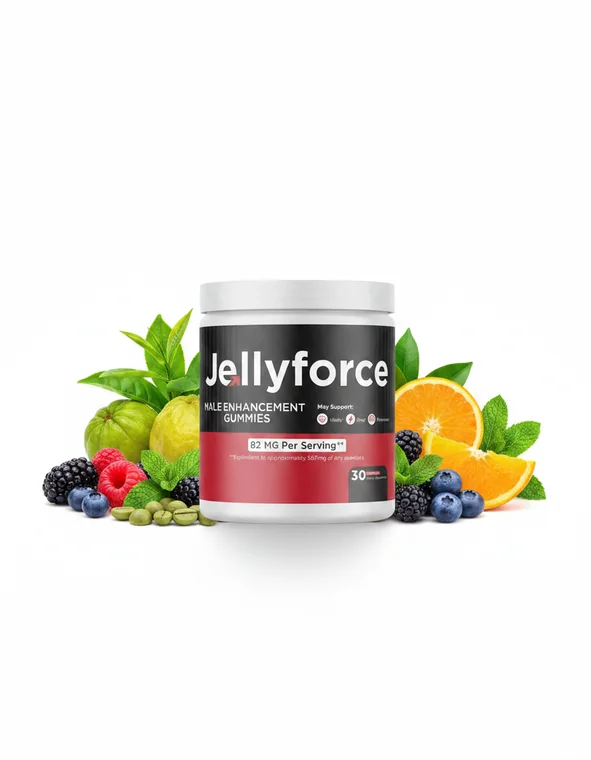
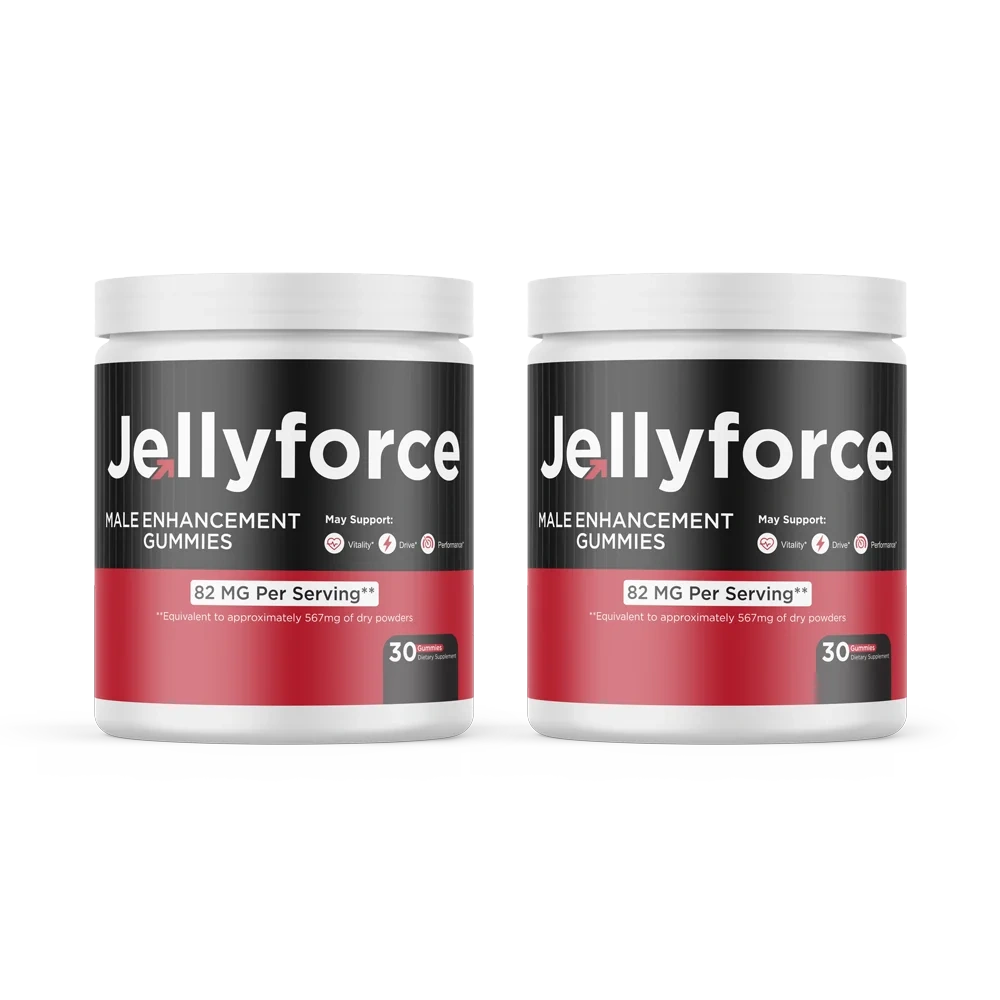
The crimson band on the Jelly Force bottle prints 82 mg a serving and a dry-powder equivalent of about 567 mg.
The Supplement Facts panel explains it: a proprietary blend of nine named ingredients, with caffeine at 5 mg the only amount given alone. The total and the order of the list are enough to compare the bottle against the published trials.
The line on the crimson band
Across the middle of every Jelly Force bottle, on a crimson band, are two lines of type:
82 MG Per Serving, and beneath it, tied to that line by a footnote marker, Equivalent to approximately 567mg of dry powders.
That band is the front-of-bottle echo of the Supplement Facts panel on the side, and the panel is where the number is explained. It reads Proprietary Blend 82 mg, lists nine named ingredients beneath it, and gives exactly one of them an amount of its own: caffeine, 5 mg.
That is more disclosure than a great many botanical gummies carry anywhere on their packaging, and it is worth knowing exactly what it does and does not let a reader work out.
Jelly Force is a dietary supplement and not a treatment. Nothing here is medical advice. Difficulty that is new, persistent or getting worse is a recognised early signal of vascular trouble and deserves an assessment rather than a purchase — a 2026 review in Nature Reviews Urology sets out why, and the NIDDK patient guide sets out what an assessment involves.
What the number does tell you
Four things, and all four are useful.
- A ceiling. Eighty-two milligrams is the combined weight of all nine named ingredients in one gummy. No single one of them can be more than that, which bounds every comparison below.
- A concentration ratio. The footnote says the 82 mg blend corresponds to roughly 567 mg of ordinary dried plant material, which is close to a seven-to-one concentration on average. That is the number to carry into a comparison with a trial, because trials of whole herbs are usually reported as dried plant weight.
- A ranking. The federal rule for proprietary blends requires the names inside to be declared in descending order of weight. With caffeine printed fifth at 5 mg, the four names after it are 5 mg or less each, and the four ahead of it share between 57 and 77 mg.
- That somebody measured something. A manufacturer printing a specific number with a specific footnote has made a statement it can be held to. A product that prints nothing has made no statement at all.
What the number leaves open
One thing, and it is the thing a reader most wants: exactly how the 82 mg divides between the nine names. Caffeine’s 5 mg is given; the other eight share the rest inside the blend, which the labelling rule allows, and no figure for any of them is estimated anywhere on this website beyond the bounds the order sets.
That matters because the nine ingredients are not interchangeable. If the blend were mostly maca it would be a different product from one that is mostly muira puama, and both would print the same crimson band. The order says muira puama is the largest share; it cannot say by how much.
| What a full panel carries | On this bottle |
|---|---|
| Serving size | One gummy. |
| Servings per container | Thirty. |
| Total amount per serving | 82 mg of proprietary blend, with a dry-powder equivalent of about 567 mg. |
| Amount per ingredient | Caffeine, 5 mg. The other eight share the blend, listed by weight. |
| Percent Daily Value | Given for carbohydrate (1%), added sugar (6%) and sodium (under 1%); not established for the blend. |
| Other ingredients | Corn Syrup, Cane Sugar, Water, Apple Pectin, Sorbitol Liquid, Natural Flavors, Citric Acid, Sodium Citrate Dihydrate. |
Every row answered except the split, and even the split is answered for caffeine and bounded for the rest.
One more thing the panel settles that the advertising does not: the list itself. The seller’s page and its INSIDE JELLYFORCE graphic name five ingredients. The panel names nine, adding green tea extract, caffeine, tribulus and horny goat weed, and a reader comparing products should always read the panel rather than the advertising.
The arithmetic the ceiling and the order make possible
Here is the useful thing about a ceiling and a ranking: you can test a product against them using the most generous assumption available, and if it still falls short, the answer does not depend on the exact split at all.
So take each name at the most the panel allows it, and set that beside the published trials.
| Ingredient | Most it can be on this panel | What the human trials used |
|---|---|---|
| Maca extract | About 33 mg of extract by the blend order; even all 567 mg of dry-powder equivalent falls short | 1,500 mg and 3,000 mg a day for twelve weeks |
| Caffeine | 5 mg, printed | attention trials with bigger effects from 200 mg |
| Ashwagandha | 5 mg, by its place after caffeine | an extract delivering 21 mg of withanolide glycosides a day, typically a few hundred milligrams of extract |
| L-Arginine | 5 mg, by its place after caffeine | grams a day, with nothing gained above 9 g |
| Tribulus terrestris | 5 mg, by its place after caffeine | 1,500 mg of a concentrated extract a day for twelve weeks |
| Catuaba extract | About 24 mg of extract by the blend order | no human dose established; in vitro work at 121 micrograms a millilitre |
| Muira puama extract | 62 mg at the very most, as the largest share | no randomised human trial of the plant alone |
The middle column gives each name the most the panel’s total and order allow, which is more than any of them can have at once. Even so, every row with a trial falls short, so the conclusion holds whatever the exact split turns out to be.
Order Jelly Force with the label read first
Nine named ingredients, an 82 mg blend printed on the panel and the front, and 60 days from purchase to decide whether it suits you.
Two bottles $158 · six bottles $294 · 60-day money-back guarantee
Order Jelly Force From This CounterLot JEL-26/JE-6975 · one a day, 30 to a bottle · ships from the United States
Why a gummy carries a small number
Not evasion. Physics.
A gummy is mostly its delivery system. On this bottle the panel spells it out: corn syrup, cane sugar, water, apple pectin, sorbitol liquid, natural flavors, citric acid and sodium citrate dihydrate, bringing 10 calories and 3 g of added sugar to every gummy. Whatever active material goes in has to fit around all of that in something a person is willing to chew and swallow. The practical ceiling is low, and it is low for every botanical gummy on every shelf regardless of brand.
A capsule holds considerably more. A powder in a scoop holds more again, which is why the maca and arginine trials could use grams: they were mixing powder into water rather than asking anybody to chew three grams of anything.
So the format itself sets the amount, and a buyer choosing a gummy is choosing adherence over concentration. That is a legitimate trade and it is only a problem when a page pretends it is not being made.
- A gummy carries tens of milligrams of active material and gets taken every day.
- A capsule carries hundreds and gets taken most days.
- A powder carries grams and gets taken for three weeks.
What a seven-to-one extract ratio actually means
The footnote on the bottle does something quietly useful: it converts. 82 mg of blend, it says, is equivalent to approximately 567 mg of dry powders. That is close to a seven-to-one ratio across the blend, and understanding what a ratio like that is claiming makes the whole label easier to read.
An extract is made by pulling the soluble fraction out of dried plant material with a solvent and then removing the solvent. Seven kilograms of dried root going in and one kilogram of extract coming out is a 7:1 extract. The claim the ratio makes is that the milligram of extract carries whatever was useful in the seven milligrams of root.
That claim is reasonable and it is not free. Two things travel badly through an extraction:
- Whatever does not dissolve in the chosen solvent is left behind. A water extract and an alcohol extract of the same bark are different products with the same name.
- Whatever is not measured is not controlled. A ratio says how much material went in, not how much of any particular compound came out. A standardised extract states a marker compound and a percentage; a ratio alone does not.
This matters most for the two Brazilian barks on this bottle. The published analysis of muira puama bark found two alkaloids accounting for about 76% of what could be measured and a phenolic fraction no higher than 1.04 mg a gram, which is precisely the kind of lopsided profile that makes extraction method decide what you end up with.
It matters least for L-arginine and caffeine, which are single compounds rather than plants. A compound has no extract ratio; it is either there in a stated weight or it is not, and caffeine is the one whose weight is stated.
So the footnote is a genuine disclosure and it is not a standardisation statement. It tells a reader the order of magnitude to compare with a whole-herb trial, which is exactly what the arithmetic above used it for.
Reading three panels side by side
The method in this article is not specific to one brand. Here is what it looks like applied to three labels a reader might pick up in the same few minutes.
| What the panel says | What can be worked out | Verdict |
|---|---|---|
| Nine ingredients in an 82 mg blend, caffeine given alone at 5 mg, dry-powder equivalent given | A ceiling, a ratio, a ranking by weight and one exact amount | The comparison can be run from the shelf |
| Eight ingredients named, no amount anywhere | Nothing. Eight names could be eight grams or eight milligrams | Unanswerable without a laboratory |
| Proprietary blend, 900 mg, twelve names inside it, no amount for any of them | A total and a ranking, and no way to know whether it is one ingredient and eleven dustings | A total without a split is worth something; one stated amount inside it anchors the rest |
The middle row is the most common label in this aisle and the least useful. The 2023 analysis is essentially a systematic version of this table run across twenty-five products.
How to use a printed amount when comparing products
- Find the total. If there is not one, you cannot run any of the steps below, and that is itself the answer.
- Find the dry-powder equivalent if one is given. It is the number that compares with whole-herb trials.
- If the total is a blend, find any ingredient with its own amount and note its place in the list. Everything listed after it weighs no more.
- Look up what the headline ingredient’s trials used. One search, one abstract.
- Compare the two most generously: give the ingredient the most the panel allows. If it still falls short, the product is a small daily dose rather than a clinical one. That is a fair thing to buy and a different thing from what the advertising usually implies.
An 82 mg blend, about 567 mg of dry-powder equivalent, nine named ingredients and one amount given alone: caffeine, 5 mg. The ceiling and the order are enough to do the comparison, and the comparison says this is a small daily dose of nine real things. The full working is set out beside every name.
- 21 CFR 101.36, Nutrition labeling of dietary supplements, paragraph (c). Code of Federal Regulations, as published by the Legal Information Institute, Cornell Law School. https://www.law.cornell.edu/cfr/text/21/101.36
- Gonzales GF, Córdova A, Vega K, et al. Effect of Lepidium meyenii (MACA) on sexual desire and its absent relationship with serum testosterone levels in adult healthy men. Andrologia. 2002;34(6):367-72. PMID 12472620. https://pubmed.ncbi.nlm.nih.gov/12472620/
- Kløve K, Petersen A. A systematic review and meta-analysis of the acute effect of caffeine on attention. Psychopharmacology (Berl). 2025;242(9):1909-1930. PMID 40335666. https://pubmed.ncbi.nlm.nih.gov/40335666/
- Lopresti AL, Drummond PD, Smith SJ. A Randomized, Double-Blind, Placebo-Controlled, Crossover Study Examining the Hormonal and Vitality Effects of Ashwagandha (Withania somnifera) in Aging, Overweight Males. Am J Mens Health. 2019;13(2):1557988319835985. PMID 30854916. https://pubmed.ncbi.nlm.nih.gov/30854916/
- Shiraseb F, Asbaghi O, Bagheri R, Wong A, Figueroa A, Mirzaei K. Effect of l-Arginine Supplementation on Blood Pressure in Adults: A Systematic Review and Dose-Response Meta-analysis of Randomized Clinical Trials. Adv Nutr. 2022;13(4):1226-1242. PMID 34967840. https://pubmed.ncbi.nlm.nih.gov/34967840/
- Kamenov Z, Fileva S, Kalinov K, Jannini EA. Evaluation of the efficacy and safety of Tribulus terrestris in male sexual dysfunction-A prospective, randomized, double-blind, placebo-controlled clinical trial. Maturitas. 2017;99:20-26. PMID 28364864. https://pubmed.ncbi.nlm.nih.gov/28364864/
- Bernardo J, Ferreres F, Gil-Izquierdo Á, et al. In vitro multimodal-effect of Trichilia catigua A. Juss. (Meliaceae) bark aqueous extract in CNS targets. J Ethnopharmacol. 2018;211:247-255. PMID 28970152. https://pubmed.ncbi.nlm.nih.gov/28970152/
- Tian X, Guo S, He K, et al. Qualitative and quantitative analysis of chemical constituents of Ptychopetalum olacoides Benth. Nat Prod Res. 2018;32(3):354-357. PMID 28750557. https://pubmed.ncbi.nlm.nih.gov/28750557/
- Petre GC, Francini-Pesenti F, Vitagliano A, Grande G, Ferlin A, Garolla A. Dietary Supplements for Erectile Dysfunction: Analysis of Marketed Products, Systematic Review, Meta-Analysis and Rational Use. Nutrients. 2023;15(17):3677. PMID 37686709. https://pubmed.ncbi.nlm.nih.gov/37686709/
- Durukan E, Jensen CFS, Grundtvig Skaarup K, Fode M. Erectile dysfunction and cardiovascular health. Nat Rev Urol. 2026. PMID 42649386. https://pubmed.ncbi.nlm.nih.gov/42649386/
- Erectile Dysfunction (ED). National Institute of Diabetes and Digestive and Kidney Diseases, National Institutes of Health. https://www.niddk.nih.gov/health-information/urologic-diseases/erectile-dysfunction